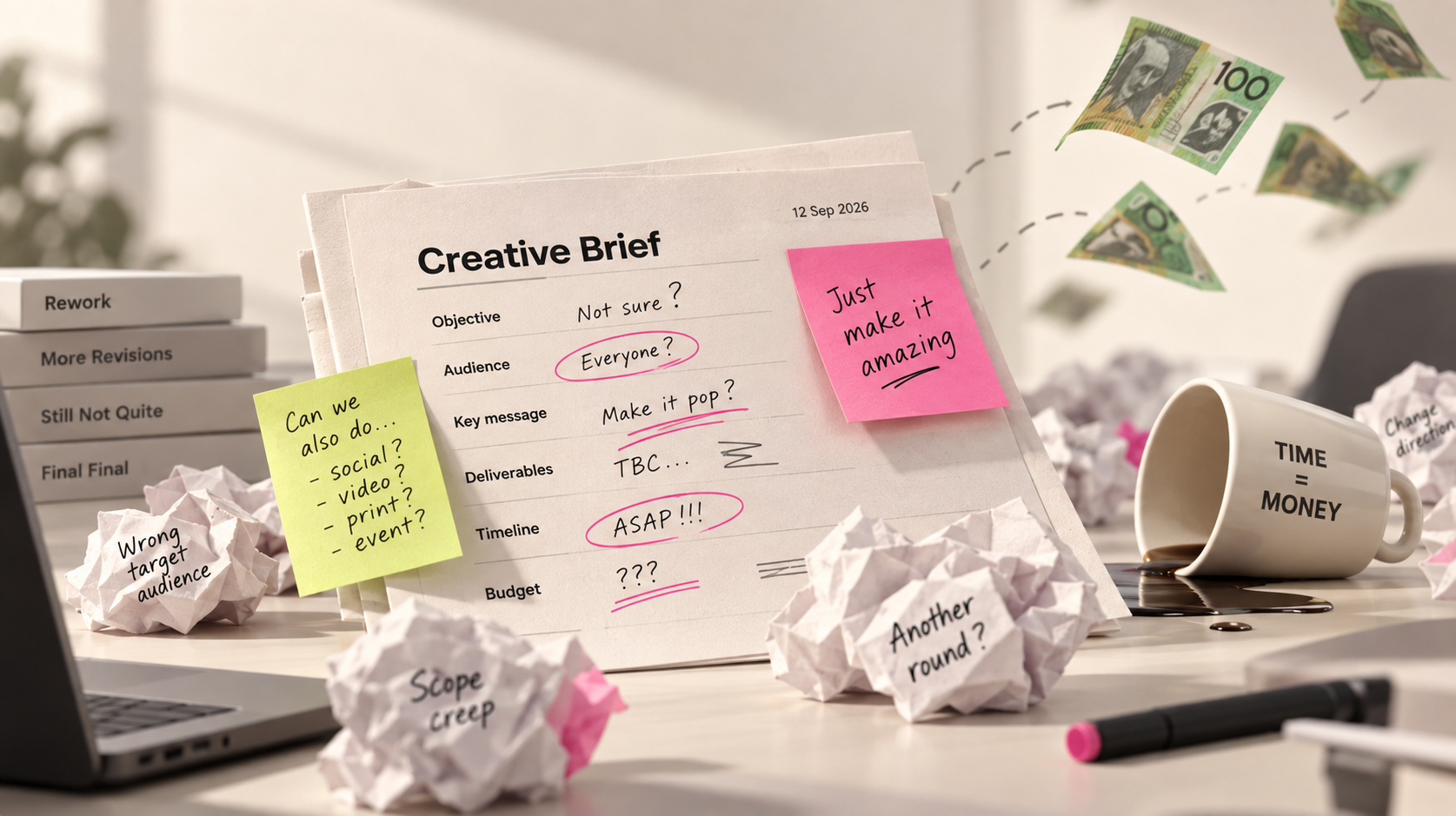

78% of the people who write briefs said theirs give clear strategic direction. 5% of the teams that deliver them agreed. That is not a small disagreement. It is two groups reading the same page and seeing two different documents.
The study surveyed marketers on one side and creative agencies on the other, but the split is not really about agencies. It shows up inside in-house teams too, with a product owner or a business unit as the writer and the creative team on the receiving end. Wherever a brief crosses from the person who wants the work to the people who make it, the same gap opens.
What the research says
| Finding | Figure | Source |
|---|---|---|
| Brief writers who think their briefs give clear strategic direction | 78% | BetterBriefs 2021, base 923 marketers1 |
| Delivery teams who agree | 5% | BetterBriefs 2021, base 782 agencies1 |
| Brief writers who admit their brief changes after it has been briefed in | 90% | BetterBriefs 2021, base 9451 |
| Delivery teams who rate the last three briefs they received as not good enough | 75% | BetterBriefs 20211 |
| What delivery teams say is most often missing: clear objectives or outcomes | 55% | BetterBriefs 20211 |
| Brief writers who admit they use the creative process to work out the strategy | 60% | BetterBriefs 20211 |
| Brief writers who want a more structured briefing | 72% | BetterBriefs 2021, base 6591 |
| Brief writers with none or very little training in writing briefs | 51% | BetterBriefs 20211 |
| Share of marketing budget respondents estimate is wasted on poor briefs and misdirected work | 33% | BetterBriefs 2021, base 1,686. The UK cut is 26%1, 2 |
| Rounds of creative development to reach a signed off idea | 5, up from 3 in 2007 | BetterIdeas 2025, 1,034 respondents3 |
| Respondents who say ideas are always judged against defined criteria | 10% | BetterIdeas 20253 |
| In-house creative leaders who name brief and intake quality a top challenge | 57% | Cella 2022, 148 leaders4 |
| In-house creatives who find getting the information to start work difficult or very difficult | 67% | inMotionNow 2018, 400+ respondents5 |
| Creative teams that produce three to five versions before a piece is done | 57% | Ziflow and AMA 2023. A quarter produce six or more6 |
| Failed projects where poor requirements were the main cause | 47% | PMI 2014, 2,066 respondents7 |
| Agencies that rarely or only sometimes charge for out of scope work | 78% | Ignition 2025, 273 agencies8 |
Nine in ten brief writers admit the brief changes after it has been briefed in. Six in ten admit they use the creative process to work out the strategy. The brief is often not the plan for the work. It is the place where the plan gets discovered, at the delivery team's expense.

The follow up study in 2025 measured the result. It now takes five rounds of creative development to reach a signed off idea. In 2007 the IPA measured three. Only one in ten respondents said ideas are always judged against defined criteria. The criteria were supposed to be in the brief.
What that costs on one job
To turn these opinions into money you need a model, and a model needs its assumptions written down. Let's take a typical scenario:
- A 20 person agency. 15 people deliver the work, 5 run accounts, traffic and the business.
- A typical job is 200 hours. Creative development is 40% of it, so 80 hours.
- A blended charge rate of A$180 an hour, and a fully loaded cost of A$85 an hour.
- At 70% utilisation the agency does about 89 of these jobs a year.
A bad brief costs hours through three channels. Each one is anchored to a finding above.
| Channel | What happens | Evidence | Hours (low / base / high) |
|---|---|---|---|
| Rework rounds | Each round of creative development beyond the second reopens 15% to 20% of that stage. Five rounds instead of three is two extra rounds | BetterIdeas: 5 rounds vs 3. Ziflow: 57% need three to five versions | 16 / 28 / 40 |
| Rebriefs | The brief changes after work starts. Strategy, planning and part of the concepting get done again | BetterBriefs: 90% change, and time lost is the cost brief writers name most | 8 / 14 / 20 |
| Chasing to start | Objectives, audience, mandatories and success measures are missing, so the team asks for them mid job, one email at a time | BetterBriefs: 55% missing objectives. inMotionNow: 67% find it hard to get the information to begin | 4 / 8 / 12 |
| Total | 14% / 25% / 36% of the 200 hour job | 28 / 50 / 72 |

The base case is 50 hours or roughly a quarter of the job. The respondents' own estimate was a third of their budget, and 26% in the UK which shows some alignment with the numbers.
| In money | Low | Base | High |
|---|---|---|---|
| Hours lost per job | 28 | 50 | 72 |
| At cost (A$85 an hour) | A$2,380 | A$4,250 | A$6,120 |
| At charge rate (A$180 an hour) | A$5,040 | A$9,000 | A$12,960 |
| Across 89 jobs a year, at cost | A$212,000 | A$378,000 | A$545,000 |
In the base case that is two and a half delivery people working all year on work that should not have needed doing. Nobody sees it as a line item. It arrives as late nights, freelancers, and a job that finished at a loss without anyone being able to say exactly why.
There is a fourth cost that is money rather than hours. Without a written scope, nobody can point to the line the client crossed. That is why 78% of agencies say they rarely or only sometimes charge for out of scope work, and why 57% lose between US$1,000 and US$5,000 a month to unbilled work.
How much of it is avoidable?
Obviously some rework is unavoidable, after all, we are human. So I set an avoidable share for each channel rather than one number for the lot.
| Channel | Base hours | Avoidable share | Why |
|---|---|---|---|
| Rework rounds | 28 | 25% | Missing objectives and undefined criteria cause some rounds. Taste causes the rest. Only one in ten teams judge ideas against defined criteria, so writing the criteria down is where the gain is |
| Rebriefs | 14 | 35% | A rebrief caused by an unasked question is avoidable. A change of mind is not |
| Chasing to start | 8 | 60% | This is the channel a good brief is built to close. The questions get asked once, at the start |
| Blended | 50 | 33% | 16.5 hours a job. 8% of the job |
A third of the cost, or 16.5 hours a job, or 8% of every job. Across 89 jobs that is about 1,470 hours a year. Nearly one full delivery person. At cost that is roughly A$125,000. If the freed hours are sold, it is A$265,000 at charge rate.
Take the low case instead, with a smaller bad brief cost and a smaller avoidable share, and it is still 625 hours a year. I cannot think of another change to a creative process that returns that much for the cost of writing a better document.
What a good brief has in it
The research is consistent about what is missing. Objectives, first and by a distance. Then the audience. Then a definition of what good looks like. And behind all of them, structure, which 72% of brief writers said they wanted more of.
So a good brief answers six questions before anyone opens a design tool.
- What is this for. The business outcome, not the deliverable. A campaign is not an objective.
- Who is it for. One audience, described in a way the team can picture. Two audiences is two briefs.
- What does good look like. The measure the work will be judged against, agreed before the work starts.
- What cannot change. Mandatories, brand rules, legal lines, the things that are not up for discussion.
- When and how much. The date, the budget, and which of the two wins if they collide.
- Who signs it off. Half of brief writers say the right people are not signing off their briefs internally1. A brief without a named approver is a rebrief waiting to happen.
None of this is new. Agencies have had brief templates for decades. The gap is not the template, it is that 51% of the people writing briefs say they have had little or no training, and the template does not tell them when they have left something out. That is a system problem, not a people problem, and it needs a system answer.
How we built Runnit around this
We started Runnit at the brief because that is where the cost starts. Here is what it does, in plain terms.
- Every client gets their own brief template. Runnit ships with a standard brief that covers the six questions above. You replace it with the client's own format, and every brief for that client starts from it.
- The client's briefing standard sits behind the template. Each template carries a guidance file that says what a good brief for this client looks like and what must not be missing. That standard is applied while the brief is being written, not at round three.
- The brief is checked as you write it. Ru, Runnit's AI operator, reads the draft against the template, the client's standard and the brand guidelines, and returns a completeness score with a list of what is missing or in conflict. It suggests an answer for each question from the client's own context and any files you have attached.
- The client's words go into the brief. A recorded conversation can be transcribed and merged into the draft, so what the client actually said is in the document.
- Nothing reaches planning unreviewed. An organisation can require the review to finish before a brief can be handed to planning.
- The brief becomes the plan. Once it is through, the same brief turns into a draft project with tasks, people, dependencies and a rework allowance, built against the capacity the team actually has. The scope baseline exists on day one, which is what makes an out of scope conversation possible later.
It works for in-house teams as well as agencies. An in-house team runs on capacity rather than budgets, so the brief produces the kind of plan that team actually runs.
If you want to see how Runnit handles a brief against your own client's standard, start free and bring a brief you have already been burnt by.
References
- BetterBriefs Project, The BetterBriefs Project: Global Report, 2021. Survey by Flood+Partners, 1,731 respondents (945 marketers, 786 agency), 70 countries. Launched at IPA EffWorks, October 2021.
- IPA, BetterBriefs best practice guide, July 2022. The UK cut, 508 respondents.
- BetterBriefs with the IPA and WFA, The BetterIdeas Project, March 2025. 1,034 respondents, 54 countries.
- Cella, 2022 In-House Creative Industry Report. Nearly 300 in-house creative leaders, surveyed January 2022.
- inMotionNow and InSource, In-House Creative Management Report, 2018. 400 or more US respondents. Reported by Adobe.
- Ziflow with the American Marketing Association, The State of Creative Workflow 2023. Vendor survey, sample size not published.
- Project Management Institute, Pulse of the Profession: Requirements Management, 2014. 2,066 project professionals.
- Ignition, 2025 Agency Pricing and Cash Flow Report, May 2025. 273 agency managers and executives.
- Laurent Bossavit, tracing the "cost of a defect" chart to IBM Systems Sciences Institute course material.
- Menzies, Nichols, Shull and Layman, Are Delayed Issues Harder to Resolve? Revisiting Cost-to-Fix of Defects throughout the Lifecycle, Empirical Software Engineering, 2017. 171 projects.